August 6, 2023 homily on Daniel Daniel 6:16-23 by Pastor Galen
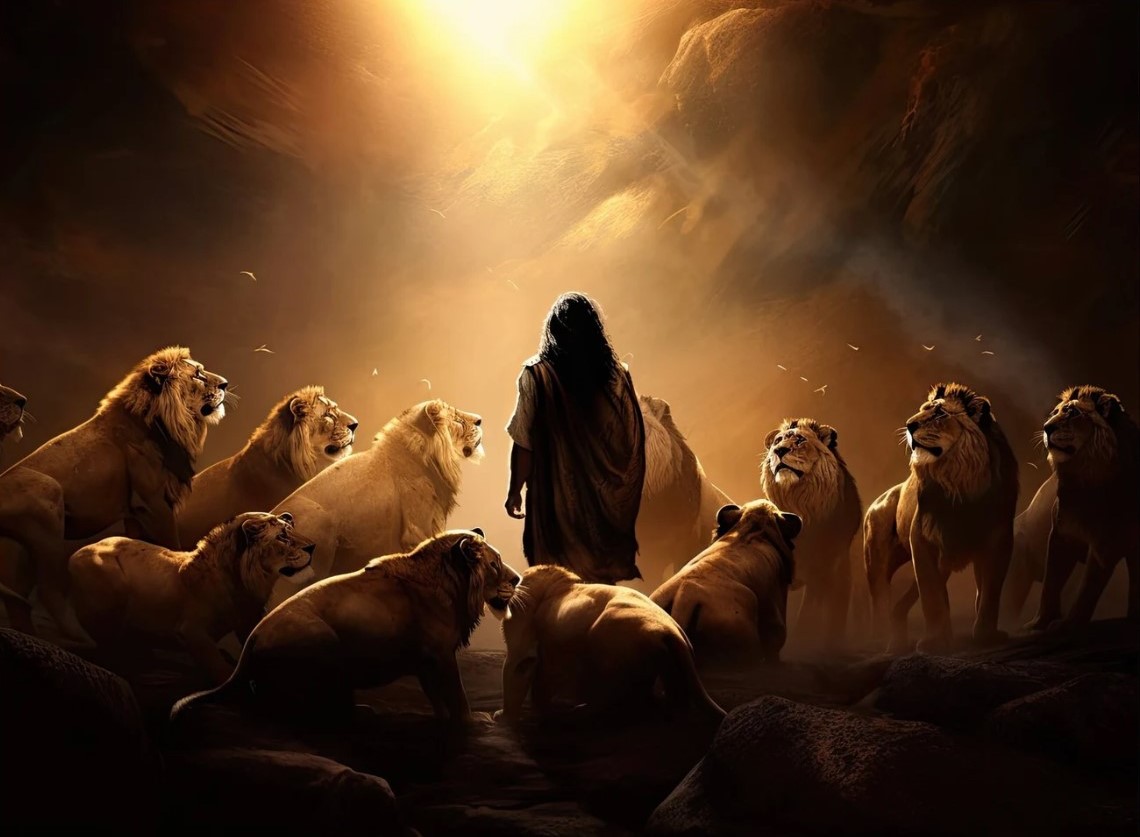
The story of Daniel and the Lion’s Den is one of the most loved and well-known stories in the Bible. As a youth, Daniel had been taken against his will to Babylon, where he eventually rose to become one of the top leaders in the Babylonian empire. He was a man of such faith and integrity that his rivals, who wanted to see his downfall, could find no fault in him. And so they invented a rule that they knew he would break, convincing the king to make it illegal for anyone to pray to anyone other than the king for thirty days. Daniel was a man of such courage and conviction that he steadfastly continued to pray to the God of heaven—despite the fact that the punishment for doing so was to be thrown into a den of lions.
Sure enough, Daniel was caught in the act of praying and was thrown into the lion’s den. But an angel of the Lord shut the lions’ mouths, and the next day Daniel emerged alive, unscathed and unharmed.
A Faith Tested and Tried
When you picture Daniel in the lion’s den, how old do you imagine him to be? Personally, I always imagined Daniel as a young man, or perhaps middle age at best. But Daniel had lived a very full life by this point. In fact, it’s estimated that Daniel would have been 80 years old when he was thrown into the lion’s den! And so Daniel’s faith was not the faith of a brash or naive young man, as David’s was when he went out to fight against Goliath. Rather, Daniel’s faith was a profound and mature faith that had deepened steadily over the years. No doubt he stumbled and fell at times, and his faith was tested and tried, but through it all God had been faithful to him, and Daniel knew that no matter what happened, God would be with him.
Tired of Giving In
When I think about how Daniel bravely and resolutely continued to pray even when it was illegal to do so, I’m reminded of the legendary civil rights hero Rosa Parks, an African-American woman who, in 1955 during the height of segregation, refused to give up her seat on a bus to a white man when asked to do so. Parks was arrested and briefly incarcerated, charged with refusing to obey the orders of a bus driver. Rosa Parks’ “arrest became a rallying point around which the African American community organized a bus boycott in protest of the discrimination they had endured for years.”
Later, Rosa Parks would say, “People always say that I didn’t give up my seat because I was tired, but that isn’t true. I was not tired physically, or no more tired than I usually was at the end of a working day…No, the only tired I was, was tired of giving in.”
The Fiery Furnace
I have to wonder if Daniel had simply grown tired of giving in as well. People don’t usually rise to the highest levels of leadership in the land by refusing to obey the orders of the king. Although Daniel was indeed a man of strong character, no doubt there were many times in the course of his life when he had been forced to give in.
There’s a well-known story found in Daniel chapter 3 that took place when Daniel was much younger, soon after he had been promoted to the position of ruler over the whole province of Babylon. The king, Nebuchadnezzar, set up a 90-foot-tall golden statue in the province of Babylon, and “sent for the satraps, the prefects, and the governors, the counselors, the treasurers, the justices, the magistrates, and all the officials of the provinces to assemble and come to the dedication of the statue…[and to] fall down and worship the golden statue that King Nebuchadnezzar [had] set up” (Daniel 3:2,5). Daniel’s three friends Shadrach, Meshach, and Abednego refused to bow down and worship the golden statue, and for their refusal to obey the orders of the king thy were thrown into a fiery furnace. But rather than being consumed by the flames, they miraculously emerged unscorched, without even a hint of the smell of smoke on them.
The question that arises for me when I hear this story is, where was Daniel when this was happening? Bible commentaries argue that Daniel was probably away on important business, visiting another part of the kingdom on behalf of the king. But it seems odd to me that the king would hold such an important dedication in the province of Babylon without the leader of the province in attendance! The more likely scenario, in my mind, is that Daniel was in fact there, and that perhaps he gave in and bowed. Or, perhaps because of his high position of authority, he was exempted from bowing, and stood by watching while those around him were forced to bow or face the consequences.
Whether Daniel was there or not, and whether he bowed or was exempted from bowing, I have to wonder if if didn’t haunt Daniel for the rest of his life that he hadn’t taken a stand against the king at that moment. Perhaps that’s why, when King Darius came to power and made a decree outlawing prayer to anyone other than himself, Daniel refused. Perhaps like Rosa Parks, Daniel had finally grown tired of giving in.
Daniel’s Non-Violent Civil Disobedience
Because you see, Daniel didn’t just break the law when he prayed to God. He did so publicly. If he had simply prayed to God in secret, he probably would have gotten away with it. But rather, the Bible tells us that Daniel “continued to go to his house, which had windows in its upper room open toward Jerusalem, and to get down on his knees three times a day to pray to his God and praise him, just as he had done previously.” (Daniel 6:10). By refusing to alter his prayer habit and by purposefully praying in front of his open window rather than in his closet to pray, Daniel was engaging in a public act of non-violent civil disobedience. Like Rosa Parks who refused to give up her seat on the bus, Daniel knowingly and publicly broke the law and willingly faced the consequences, because the law was unjust and it was the law that needed to change, not him.
Now, in talking about the civil disobedience that Daniel and Rosa Parks displayed, I’m not talking about the type of civil disobedience that many churches participated in by refusing to abide by the guidelines set forth by the CDC during the COVID pandemic.
In so doing, they were putting their most vulnerable members even further at risk.
Rather, the non-violent civil disobedience that we see modeled by Daniel and by Rosa Parks is a non-violent civil disobedience marked by self-sacrificial love, characterized by a willingness to lay down one’s own life for the good of others. Daniel willingly broke the law and prayed in public, knowing that given his high position and impeccable character, his arrest and punishment would undoubtedly catch the king’s attention and would lead to a change in the law, which in fact it did.
Rosa Parks, too, was someone who was held in high esteem by others and was actively involved in the Methodist church she attended for her whole life. I believe Parks knew that her arrest would help sway public opinion, for she was not just trying to change the law for herself, but for those of us who would come after her as well. Indeed, it was Rosa Parks’ faith in God that gave her the courage to stand up against segregation. As she described it, “I instantly felt God give me the strength to endure whatever would happen next. God’s peace flooded my soul, and my fear melted away. All people were equal in the eyes of God, and I was going to live like a free person.”
The Example of Christ
Of course, when we think about examples of non-violent civil disobedience marked by sacrificial love, there’s no better example than that of Jesus Christ. Jesus always did the right thing, no matter the consequences. And quite frequently that involved breaking the unjust rules that the religious leaders of his day sought to enforce. Jesus healed people on the Sabbath. He touched lepers, even though it was strictly forbidden to do so. He talked with women in public, even though society considered it wrong. Jesus could have told those who were sick on the Sabbath to simply come back the next day. He could have healed the lepers without touching them. He could have refused to talk to the Samaritan woman, and no one would have thought any less of him. But Jesus refused to give in, and willfully broke the spoken and unspoken rules of his day, because the laws were unjust and needed to change.
Jesus is the ultimate example of self-sacrificial love, as he willingly laid down his life for us. Jesus never broke God’s law, and was therefore undeserving of the punishment that he endured, but Jesus died in our place to take the punishment for our sins, living the life we should have lived, and dying the death we should have died, thereby freeing us from bondage to sin, and death and the grave. As we’re told in 2 Corinthians 5:21, “For our sake God made the one who knew no sin to be sin, so that in him we might become the righteousness of God.” Jesus freed us, because of his great love for us.
Conclusion
Now, doing the right thing doesn’t always involve a public act of civil disobedience. Doing the right thing, however, might involve refusing to lie when your boss asks you to. It might mean refusing to cheat on that assignment at school, even when everyone else seems to be doing it. It might mean associating ourselves with the types of people that society tells us we shouldn’t associate with. Often there are consequences. Doing the right thing might mean losing a job. It might mean missing out on opportunities with our friends. It might mean having others turn their backs on us.
Fortunately, there is grace for those times when we’ve compromised our convictions or given in. God is a God of second and third, and hundredth chances. But may we, like Daniel, grow more and more in our courage and conviction to do the right thing, no matter the consequences. Like Rosa Parks, may we grow tired of giving in, and may God give us the courage to stand up against injustice, and live as free people. And make we “[look] unto Jesus the author and finisher of our faith; who for the joy that was set before him endured the cross, despising the shame, and is set down at the right hand of the throne of God” (Hebrews 12:2), where he intercedes for us.
Amen!
 Hampden United Methodist Church