
September 17, 2023 homily on Romans 14:1-12, 17 by Pastor Galen
“For the kingdom of God is not food and drink but righteousness and peace and joy in the Holy Spirit.” – Romans 14:17
Food and Drink
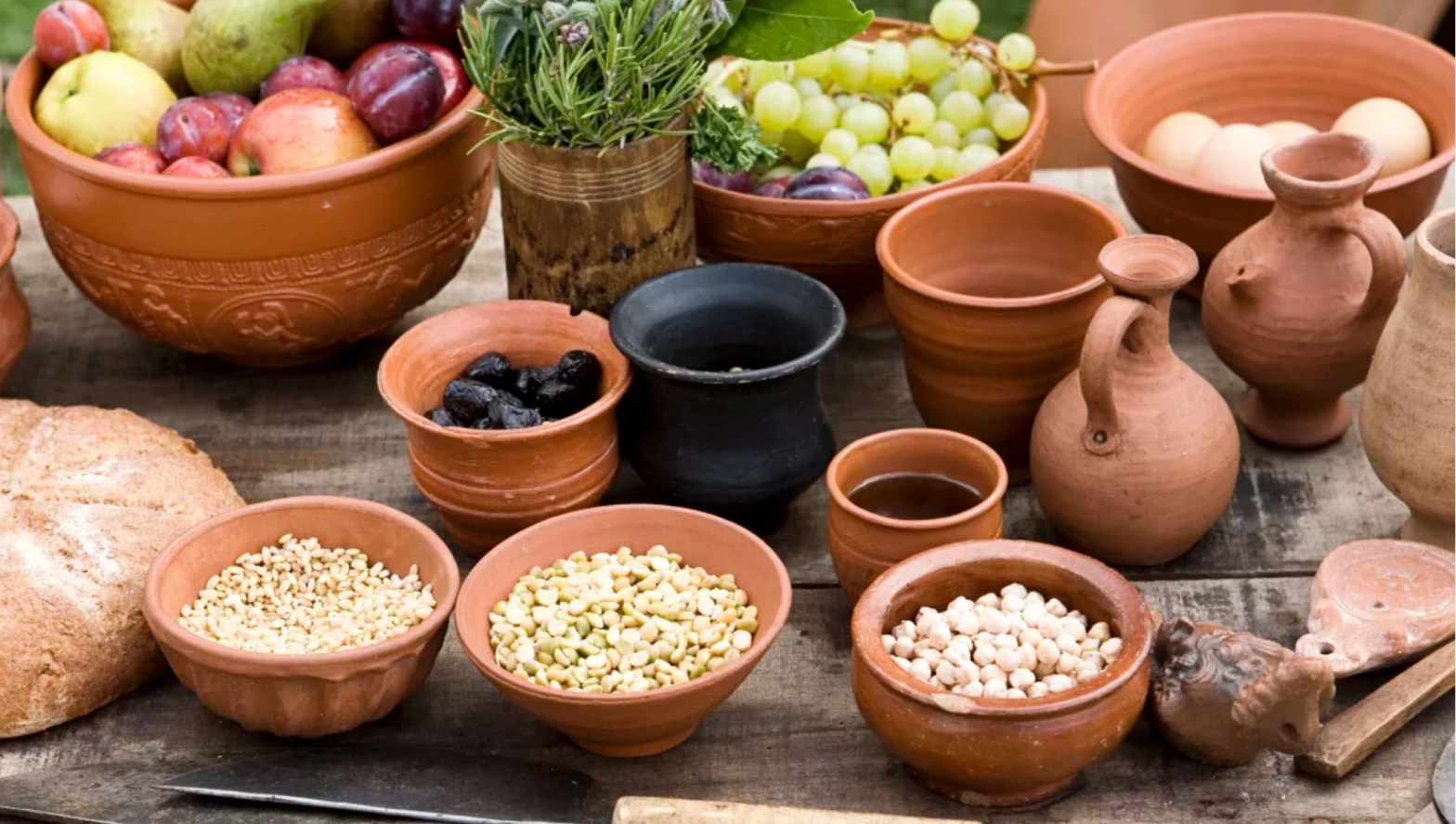
Human beings have an interesting relationship with food and drink. On the one hand, we need food and water in order to live, and yet what we consume is not always what is best for us. As a society, we struggle with a lot of diseases that are related to our dietary habits. We also know that certain types of food and drink can become addictive. On top of that, different people have very different opinions about what types of food and drink are appropriate to consume, or taste best, or are the best for us. And then of course there is the way that food is connected to our culture and identity. The food we eat in many ways shapes the way we think about ourselves and who we are. (For example, how many coffee drinkers are in the room? How many of you are tea drinkers?) Food and drink both unite us and divide us.
The Apostle Paul’s letter to the church in Rome seems mostly concerned with the core and essence of the Gospel. And yet, here in the 14th chapter of the book of Romans, Paul seems to spend a lot of time talking about food and drink, pointing out that “the kingdom of God is not food and drink…” (Romans 14:17). We might ask ourselves, why does Paul even bother to talk about this? Who thinks that the Kingdom of God is about food and drink? And what does all of this have to do with the Gospel?
To understand what led up to Paul making such a statement, we have to understand a bit about what was happening in the church in Rome.
The Church in Rome
The church in Rome had been founded by Jewish Christians who had been visiting Jerusalem during Pentecost when the Holy Spirit fell upon Jesus’ disciples. After they too received the Holy Spirit and were baptized, they returned to Rome, and began meeting together regularly to study the life and teachings of Jesus, all the while continuing to keep their Jewish customs and traditions and dietary habits.
When the emperor Claudius expelled all of the Jewish people from Rome around 50 C.E., the leadership of the church in Rome fell to the Gentile (non-Jewish) converts to Christianity who remained in the city. The church in Rome began to take on a decidedly Gentile flavor, such that when the Jewish Christians returned to Rome following Claudius’s death, they hardly recognized it. The Jewish Christians no doubt lamented what they felt was irreverent disregard for the traditions they held dear, such as circumcision, keeping the Sabbath on Saturdays, and the Jewish dietary code, and this was no doubt evidenced in the church potluck dinners, where some of the meat that was served had been previously sacrificed to idols, and not all of the food was Kosher. The Gentile Christians, for their part, were no doubt frustrated that the Jewish Christians were holding so tightly to what they felt were archaic cultural practices and traditions that had nothing to do with the Gospel.
And so the Apostle Paul stepped in, to remind them that in the end, the Kingdom of God is not about food and drink and religious rituals, and that what unites us as believers in Christ is more than what separates us. And, he gives guidance about how we can live together in community with other followers of Christ who have different convictions than we do, even when it comes down to something so basic as food and drink.
Freedom From Petty Tyrannies
Eugene Peterson’s paraphrase of Romans 14 in The Message may be helpful here. Peterson says,
Welcome with open arms fellow believers who don’t see things the way you do. And don’t jump all over them every time they do or say something you don’t agree with—even when it seems that they are strong on opinions but weak in the faith department. Remember, they have their own history to deal with. Treat them gently. For instance, a person who has been around for a while might well be convinced that he can eat anything on the table, while another, with a different background, might assume he should only be a vegetarian and eat accordingly. But since both are guests at Christ’s table, wouldn’t it be terribly rude if they fell to criticizing what the other ate or didn’t eat? God, after all, invited them both to the table. Do you have any business crossing people off the guest list or interfering with God’s welcome? If there are corrections to be made or manners to be learned, God can handle that without your help (Romans 14:1-4, MSG).
And then a few verses later,
What’s important in all this is that if you keep a holy day, keep it for God’s sake; if you eat meat, eat it to the glory of God and thank God for prime rib; if you’re a vegetarian, eat vegetables to the glory of God and thank God for broccoli. None of us are permitted to insist on our own way in these matters. It’s God we are answerable to—all the way from life to death and everything in between—not each other. That’s why Jesus lived and died and then lived again: so that he could be our Master across the entire range of life and death, and free us from the petty tyrannies of each other (Romans 14:6-9, MSG).
I love that phrase “free us from the petty tyrannies of each other.” What an apt description of the way that we so often try to force our own religious, spiritual, and cultural preferences onto others! And indeed, here we see the link to the Gospel. Because Jesus came not only to break down the wall that divided humanity from God, but also the walls that divide us from one another. And so Paul wants us to remember that we cannot allow these petty differences to divide us, because the Kingdom of God is not about food and drink, but rather it is about righteousness, peace, and joy in the Holy Spirit.
More than Food and Drink
Of course, there are many other beliefs and practices that threaten to divide us as Christians, in addition to food and drink, but the same principles apply. Because there are many times when, individually or collectively, we might develop a particular conviction around something. This might be based on our personal or communal experiences, or a conviction from the Holy Spirit, or our interpretation of Scripture, or a mixture of all of the above. And this is good. But the problem comes in when we try to concretize the particular application of these convictions and then apply them unilaterally to all Christians, believing that everyone around us should live out our principles in exactly the same way. This is when we run the risk of falling into legalism and judgementalism.
Professor and preacher Haddon Robinson explained in this way. He said,
When an abstract concept says, for example, “You shall honor your father and mother,” it’s clear that’s what you’re supposed to do. But then I apply it to my aging parents. When my father came to live with us, he lost touch with reality, and we had to put him in the nursing home. I hated to do it, because he didn’t like to be there. But when my wife’s mother came to the end of her life, we kept her in our home, and my wife took care of her. It is very easy to come to the conclusion that if you are going to honor your parents, then you must keep them in your home when they get old. But there was a different situation—our kids were grown when [my wife’s] mother was ill. In both cases I was trying to honor my parents. Legalism is when the application of a principle is given all the force of the principle itself. (Expository Preaching in a Narrative World: An Interview with Haddon Robinson, Michael Duduit, editor, Preaching Magazine, July/August 2001)
“Legalism is when the application of a principle is given all the force of the principle itself.” And so, as in the quote often erroneously attributed to Thomas Jefferson, “In matters of style, swim with the current; in matters of principle, stand like a rock.” (https://www.monticello.org/research-education/thomas-jefferson-encyclopedia/matters-style-swim-currentspurious-quotation/#fn-1) We swim with the current when it comes to matters of style, but in matters of principle we stand like a rock. But we don’t try to enforce our particular applications of those principles onto others, nor should we look down on others who don’t hold those same convictions. Rather, as Christians we are to welcome and embrace those who hold different convictions than us, and seek to listen and understand one another so that we can best support and encourage one another in our faith journeys. Because we have not all had the same experiences, and there is much that we can learn from one another.
Holding Our Convictions with Grace
As I was pondering this week how we can learn to hold our particular convictions with grace towards other believers who hold different convictions than us, I came across an article written several years ago by D.L. Mayfield entitled, “Why I Gave Up Alcohol.”
As I’m sure you’re aware, there is a wide spectrum of beliefs and convictions across various Christian traditions when it comes to the consumption of alcohol. Some Christian traditions (including the one in which I grew up), strictly forbid their members from drinking any and all alcoholic beverages. On the other end of the spectrum, Martin Luther once said, “If our Lord is permitted to create nice large pike and good Rhine wine, presumably I may be allowed to eat and drink.” (Source: Martin Luther, “Martin Luther–The Early Years,” Christian History, no. 34.) Methodists have for a long time “support[ed] abstinence from alcohol as a faithful witness to God’s liberating and redeeming love for persons” and encourage “judicious use with deliberate and intentional restraint, with Scripture as a guide…with regard to those who choose to consume alcoholic beverages.” (https://www.umcjustice.org/who-we-are/social-principles-and-resolutions/the-social-community-162/the-social-community-alcohol-and-other-drugs-162-l)
Anyway, D.L. Mayfield (who goes by they/them pronouns), wrote what I think is a wonderful article expressing their personal convictions in a way that shares their experiences while extending grace towards those who may not have come to the same conclusion they did. Mayfield’s article invites all of us to consider what it could look like for us to stand in solidarity with those who struggle in ways that we may not.
Mayfield wrote,
Our first shock when we moved into [a low-income neighborhood] was the amount of substance abuse that surrounded us … I would go to get my mail and find a man blocking the stairs, passed out and unresponsive at 11 in the morning. We have neighbors who… suffer from alcohol-related psychosis and bang symphonies on the trees outside our window at all hours of the night … Empty vodka growlers line the living room of one… There are people in our building who die because of alcohol…And suddenly, alcohol is no longer fun. Instead it is a substance that changes my friends and neighbors, making them unpredictable and unsafe … There are other neighbors here too, people who are in various stages of recovery … They shake their heads and tell me they don’t touch the stuff anymore. They find that every sober day is a gift.
After a year of living among them, I gradually…dreaded going to the liquor store, imagining the faces I would see there. I saw my neighbors get off the bus with a 12-pack in each hand, and I was less likely to get a beer the next time I was out. Eventually, I realized I could abstain from alcohol entirely, that it could even be a spiritual discipline for me—a way to pray and identify with my literal neighbors, who could not stop … Since so many were caught in the cycle of stumbling and picking themselves up again, it became good for me to not drink, as a way to stand with the brothers and sisters I was learning to love. ( D.L. Mayfield, “Why I Gave Up Alcohol,” Christianity Today, June 2014)
Oh that we would all find ways to stand with those we are learning to love. Oh that we would all be able to express our our convictions with such grace, rather than looking down on or despising those who do not hold to the same convictions that we do. May we too learn what it looks like to love all of our siblings in Christ, and may we stand in solidarity with those who are suffering, even as Christ stood in solidarity with and extended grace to us.
Amen!
 Hampden United Methodist Church