
November 17, 2024 homily on Mark 10:13-16 by Pastor Galen
“[Jesus] said to them, “Let the little children come to me, and do not hinder them, for the kingdom of God belongs to such as these” – Mark 10:14
A Shared Experience
Yesterday, Eboni and I accompanied our youngest daughter and her Girl Scout troop to the Enoch Pratt Central Library downtown, where we attended a Printmaking Workshop open to all ages. This hands-on activity provided the opportunity to learn about and experiment with various artmaking techniques using ink and paint. Afterward, most of us headed downstairs to the library’s children’s area for a family-friendly robotics activity. There, parents and kids worked together on the floor, using color-coded cards to “program” a robotic car to move in different directions.
For both activities, parents had the option to drop off their children and return later. However, most of us chose to stay—either actively participating alongside our kids or remaining nearby to observe and share in the experience. We wanted our children to have a great time and we wanted to share in the moment with them.
The parents mentioned here in the Gospel of Mark similarly wanted to have a shared moment and create positive memories with their children, and so Mark tells us that they were bringing their little children to Jesus so that he could bless them (Mark 10:13a). Surely meeting Jesus was a once-in-a-lifetime opportunity for these parents, and so they wanted their children to share in this experience with them! Plus, they knew that Jesus had the power to heal and perform miracles, and so as parents who wanted good things for their children, they wanted Jesus to bless and pray for their children.
Turned Away At the Door
Imagine how the families must have felt, then, when they were turned away at the door by Jesus’ own disciples! And not just turned away, but, Mark tells us that the disciples actually scolded, or “rebuked” them! (Mark 10:13b). I can imagine the disappointment the children must have experienced, and the anger, frustration, and embarrassment the parents must have felt.
Several years ago when our youngest daughter was still a toddler, my 3 daughters and I had an experience of being turned away at the door of a “family-friendly” activity.
It was early on a Saturday morning, and I wanted to give my wife a little break and let her rest, so the girls and I piled into the van and we drove 30 minutes to a place I had heard about, which I’ll refer to as “Storytown.” When we got there, however, we were told that they only allowed toddlers and their caregivers could come inside, and although my youngest daughter fit perfectly into the category of toddler, my oldest daughters were too old to visit storytown.
Not able to leave my oldest daughters outside, alone and unattended while I went inside with my youngest daughter, I asked if we could all come in and share the experience together. Sure, my older daughters were too old to enjoy the toddler-themed activities for themselves, but they could help and assist my youngest daughter, I insisted. Or they could sit quietly over on the side and simply watch if that would be better. I tried every argument I could think of, and even asked to speak with the manager, but she refused to budget, stating that it was their policy, and there were absolutely no exceptions. And so we turned around and drove home — the girls were disappointed, and I was angry and frustrated, while also embarrassed, fearing that I had made a spectacle of myself.
Now, the families who were turned away by Jesus’ disciples had no idea that the disciples were acting on their own accord, and that they were not speaking for Jesus. And so they too probably came away angry, and frustrated,and confused, asking themselves “Why couldn’t Jesus have taken just a few minutes to bless and pray for my child? Doesn’t Jesus care about children? Doesn’t he care about our family?” All they wanted was for their child to be blessed by Jesus. Was that too much to ask?
“Seen and Not Heard”?
But of course the disciples were not speaking for Jesus when they turned the families away. In fact, Jesus was “indignant” (or as it says in the King James Version, “much displeased”) when he saw that the disciples were turning children away.
Which begs the question, why were the disciples turning the children away in the first place? Nothing that Jesus had ever said or done should have led his disciples to believe that Jesus didn’t care about children. So why were they rebuking and scolding families for bringing their children to Jesus?
We don’t know why they did this, but the previous verses indicate that Jesus and his disciples were in a house, and they had been asking Jesus questions about some of his recent teachings. Perhaps the disciples wanted Jesus’ attention all for themselves, and they were upset that the children and families were interrupting their alone time with Jesus.
Or, perhaps the disciples had been raised in the old school mentality that “children should be seen and not heard.” Maybe they would have been fine with children being in attendance while they were talking with Jesus, as long as they were quiet and well-behaved and didn’t interrupt the flow of the “adult” conversation. Or, maybe they didn’t think that the content of the conversation was appropriate for small ears to hear.
Caring for Children, and Their Caregivers
The truth is that there are a lot of ways that children and families can be made to feel unwelcome — even in the Church. And I don’t just mean the angry sideways glances that so often occur in a lot of churches when a child starts to get restless or a baby starts to cry. (The most extreme example I’ve experienced of this is when our family attended a choir concert at a large, very formal church in Washington, D.C. The concert was being broadcast on TV, and so they made an announcement at the beginning of the service that there was to be absolutely no noise during the program. I was so nervous throughout that one of our daughters might shift positions or worse — cough — that I felt like I was sitting on pins and needles throughout the whole concert!)
There are other times when we in the Church have the best of intentions, but the wrong message comes across. Often we want children to have age-appropriate learning and safe experiences, and so we provide alternative places for children to learn and engage during our worship services. But one of my friends, who is a parent with young children, told me that she doesn’t want to take her children to church if they’re sent off to a separate Sunday School class, because she doesn’t know what sort of teaching they’ll be exposed to. She wants to keep them in the service with her.
Other times, our desire to create safe places for families might leave parents feeling ostracized or disconnected. Ever since I’ve been here at Hampden UMC, I’ve always announced that we have a nursery available for children and their caregivers in the basement of our church. I’ve made this announcement with the best of intentions — I wanted families to know that there is a space set aside where they can take their children if their children get restless. I wanted parents to know that they can have the freedom to do what is best for their children. But a parent once told me that if they have to take their child out of the service to take them to the nursery, then they might as well stay home and not even come to church, because as a parent they’re missing out on the opportunity to worship and fellowship with other adults.
Creating Welcoming Spaces for Children
And so, with all of this in mind, over the past few years, I’ve been talking with pastors, parents and children’s ministry directors in a variety of church settings and researching some of the innovative ways that churches are working to create welcoming spaces for children and families in their worshiping communities.
One of the things I’ve learned is that there is no “one size that fits all.” Families have a variety of needs depending on the ages and stages of their children, and where they are in their faith development, and how much or how little the parents trust churches or institutions. And so with that, the key is to provide as many options as possible, so that parents can make choices that are best for them and their little ones.
And so for some, having a separate nursery where they can take their children will be best. Others might prefer that someone else watch their children during the service so that the parents can participate fully in the service, knowing that their children are being loved and taken care of. Others will want to make sure that their children are getting good solid Biblical teaching that is welcoming and affirming and inclusive, and so they’ll want to preview the curriculum before they sign their children up for Sunday School or Vacation Bible School. And so we’ll continue to provide these sorts of options, as we’ve done in the past.
PrayerGrounds
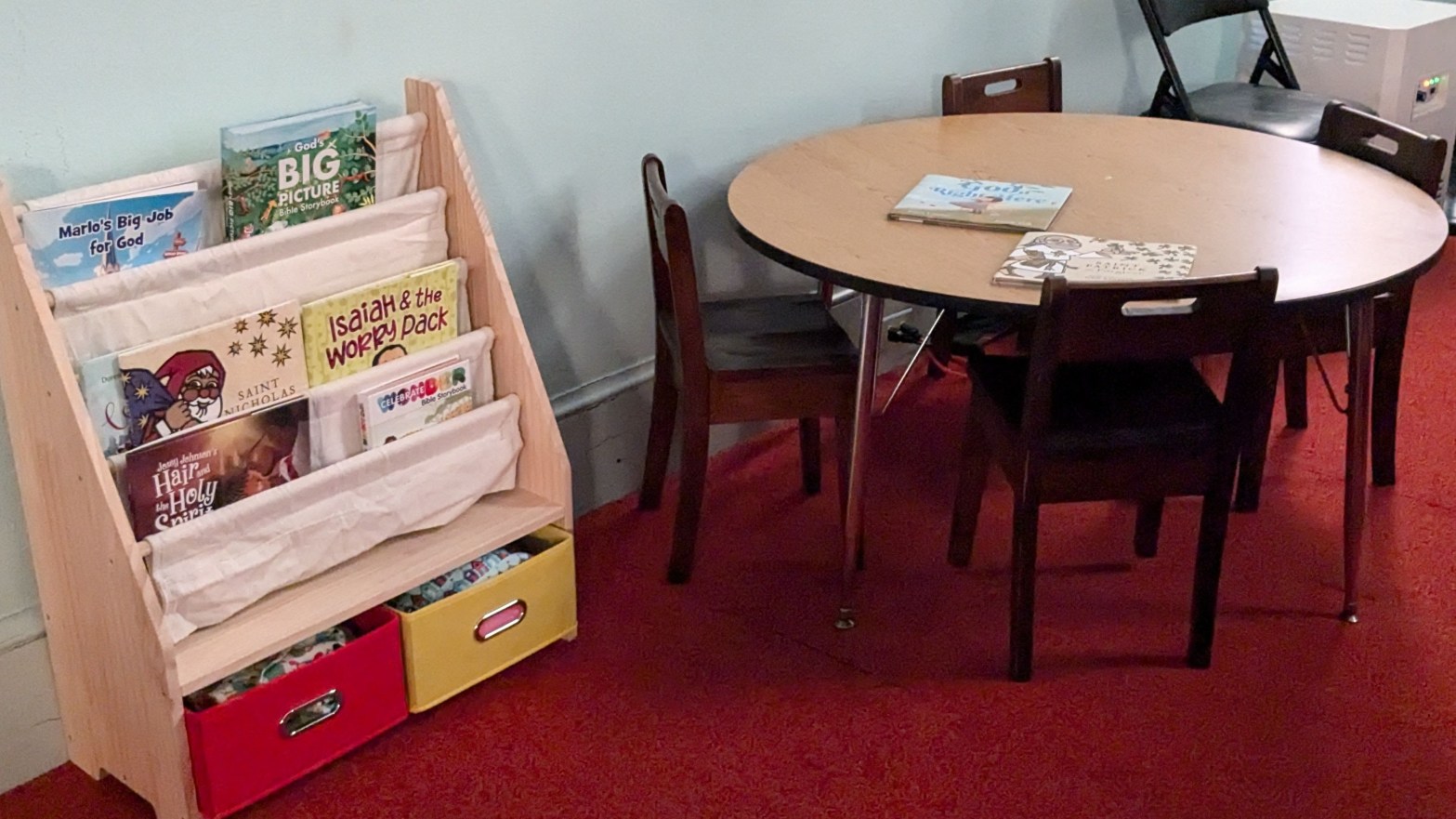
But in the midst of my research, and especially in trying to figure out how to care for parents who might want to keep their child in the worship service without making them feel like they are “sitting on pins and needles,” I came across something called “praygrounds.” Not “playgrounds,” but rather sacred spaces in church sanctuaries that are set aside specifically for children, so that the children can move around and learn and explore and worship and pray, all within eyesight of their parents, while also having the opportunity to fully participate in the service.
Some churches have these sorts of spaces right up front, so that little ones can play on the floor and see and hear what’s happening. Other churches, such as our neighboring church Good Shepherd UMC, have these sorts of spaces near the front but over to the side. Good Shepherd actually removed a whole section of pews to make room for their prayerground, and my daughter loves being in that space when we participate in joint worship services at Good Shepherd. Still other churches put these sorts of spaces in the rear of their sanctuary so that children can move around freely, while others have several spaces scattered throughout the sanctuary so that families have a variety of options to choose from.
This is Where Children Belong
The point of all is that we as Jesus’ disciples are called to welcome children and families, not rebuke or scold them or push them away, as Jesus’s original disciples did. That’s why Jesus rebuked his disciples, and told them not to stop the little children from coming to him. That’s why he called the children to himself, and took them in his arms, and blessed them — showing the children and their parents that they were in fact welcome and loved. In fact, Jesus said, the “kingdom of God belongs to people who are like these little children” (Mark 10:14). Therefore, Jesus said that we “must accept the kingdom of God as a little child accepts things, or [we] will never enter it.”
And so may we love and nurture and welcome children, as Jesus did, not only because they are dearly loved by God, but because there is much that we can learn from them, about how to trust and depend on God. Just a little child inherently depends on their parents and caregivers, so too we are called to recognize our own need and dependence on God.
And so, like Jesus, may we welcome children in our midst. May we create spaces of radical welcome and inclusion for all types of children and their caregivers and for people of all ages and stages of life. May we create spaces where families can create shared memories of faith and worship together, and may we remember that this is the place where children belong!
Amen!
 Hampden United Methodist Church