August 24, 2025 homily on Deuteronomy 6:4–9 and Mark 12:28–34 by Pastor Galen
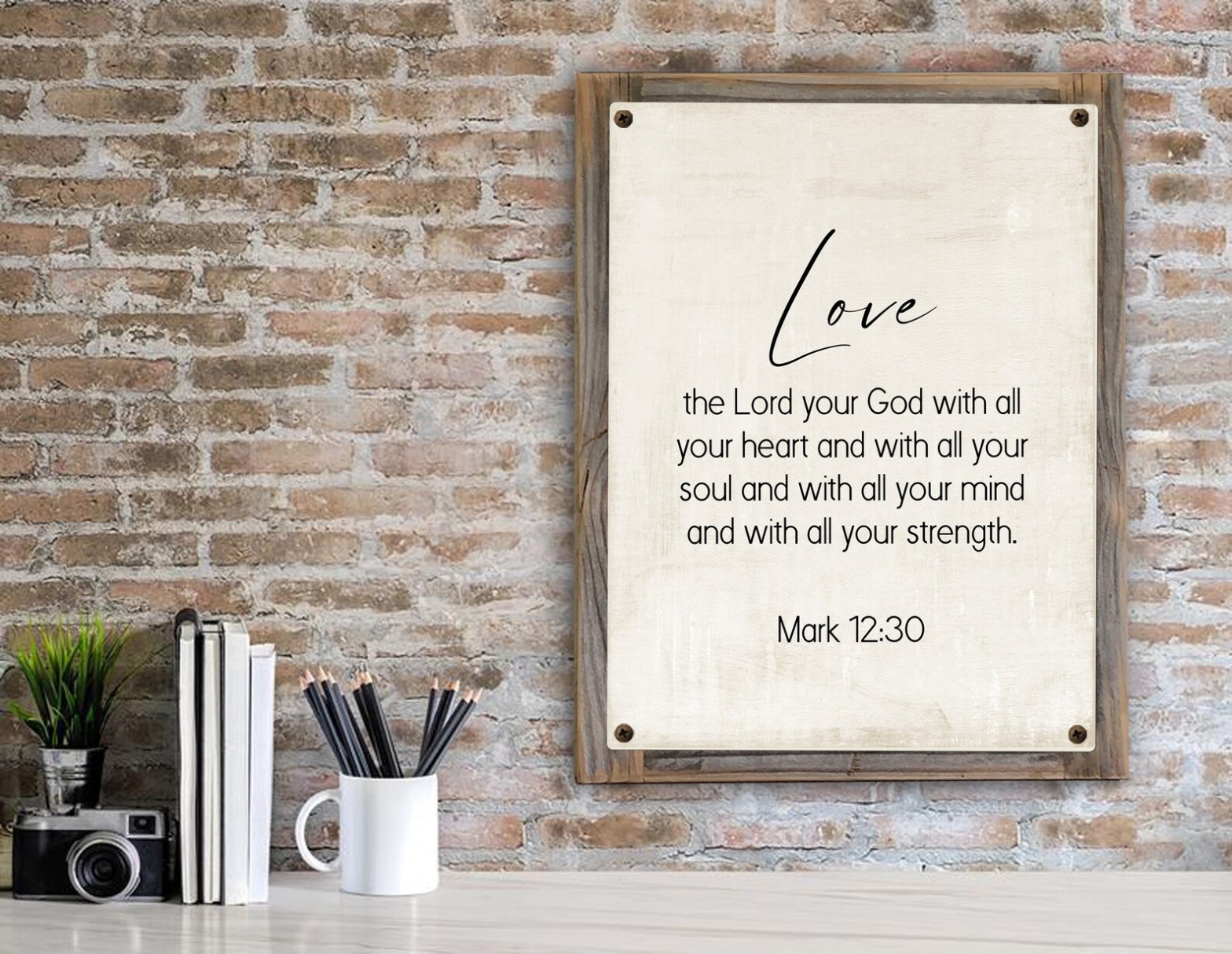
“‘Love the Lord your God with all your heart and with all your soul and with all your mind and with all your strength.’’ – Mark 12:30
In college, I majored in visual and performing arts, with a concentration in photography. I spent countless hours in the darkroom, surrounded by trays of chemicals, enlargers, and rolls of film. My head became filled with knowledge about how to develop and print pictures—a whole set of skills that, in today’s digital age, feel almost obsolete.
For years after I graduated, people would ask me, “So, are you using your photography degree?” The short answer was, “Not directly.” I did work briefly as a school portrait photographer and wedding photographer right after college, but soon afterwards I answered the call into ministry, and haven’t worked in professional photography since. And yet my college years were certainly not wasted, because the real value of my education wasn’t just learning how to take pictures or develop film. It was about learning how to learn.
Learning How to Learn
My professors in college told us that their primary goal was to teach us how to engage in the creative process—how to experiment, research, and try again when something didn’t work. In the darkroom, mistakes happened all the time: a picture came out too light, too dark, or sometimes the entire roll of film was ruined. But that was part of the process of learning, and sometimes those mistakes even led us to go in a completely new and different direction, one that was even more creative than what we had planned in the first place.
And I’ve come to believe that this is what education is really about. It’s not simply about memorizing facts. It’s about developing the tools and habits to be curious, to study, to reflect, to discover. Many of us work in careers very different from what we studied in school. But the foundation that we were given in school — the ability to learn — the skills and knowledge we acquired about how to do research, or conduct experiments, or to engage the creative process — is what sticks with us.
Heart, Soul, Mind, and Strength
That brings me to the scripture we read this morning. In Deuteronomy 6, Moses commanded the Israelites: “You shall love the Lord your God with all your heart and with all your soul and with all your might” (Deuteronomy 6:5). And in Mark 12, when Jesus is asked about the greatest commandment, he quotes this verse, saying, “You shall love the Lord your God with all your heart and with all your soul and with all your mind and with all your strength” (Mark 12:30).
In saying that we should love God with all our heart, soul, mind, and strength, Jesus gives us a vision of a love for God that encompasses our whole person. We are not asked to love God only with our hearts or emotion; or only with our minds, or intellect, or only through physical acts of service with our bodies. We are called to love God with each and every part of who we are.
Notice especially that Jesus highlights the mind. Loving God is not just about feelings, passion, or action. It also involves study, reflection, and learning. When we study God’s Word, when we wrestle with difficult questions, when we try to understand how our faith connects with the world around us, we are loving God with our minds.
Passion and Knowledge Together
And here’s the thing: passion and knowledge often feed one another. When we’re passionate about something, we naturally want to learn more. And the more we learn, the deeper our passion grows.
You’ve probably experienced this if you’ve ever taken up a new hobby. Perhaps you enjoy listening to music, and so you decide to learn to play a musical instrument. You have the passion, but no knowledge. And so you start to learn the technique, and the theory. You practice, and the more you learn, the more that the music you listen to starts to take on a new richness. Or think of science: A passion for animals can lead someone to study biology, or curiosity about rocks leads someone to study geology, and the more we learn, the more it fuels our passion to learn more, as we see how much more there is to learn.
Faith often works the same way. The more we learn about God and Jesus and the Bible, and the more we reflect on what we learn, the more our hearts are drawn to God. And the more our hearts are stirred with love for God, the more we want to keep learning. Heart and mind go hand in hand.
Heart and Soul
But there is one dimension that schools cannot fully provide. Schools can train the mind, they can nurture creativity, they can provide us with opportunities to grow in our passion and our skills. But only God can shape the soul.
Yes, most fields of study include courses in ethics, and those are important. It’s important to know the professional standards of medicine, or law, or business, or journalism. But there is a difference between learning about right and wrong in the abstract, and having your soul formed in the image of Christ. A person may know all the rules of ethics and still use their passion and knowledge in ways that are selfish, greedy, or destructive.
And this is where the role of the church becomes so crucial. Schools are designed to equip the mind, but the church is the place where hearts and souls are shaped for eternity. Here, in worship, we lift our voices in praise to God. Here, in prayer, we learn to bring our burdens and hopes before the Lord. Here, in community, we are stretched and challenged to love people who are different from us, to forgive, and to be forgiven.
This is why I believe that educational institutions and faith institutions are both so important, and why they often go hand in hand. It’s why churches have long been supporters of education and have often been on the forefront of literacy efforts. From the earliest monasteries where monks carefully copied manuscripts by hand, to the Sunday school movement that began not just as a place for Bible teaching but as one of the first organized efforts to teach under-resourced children to read, the church has long recognized that nurturing the mind is part of nurturing the soul.
The skills we develop in school — literacy, research methodology — are vital if we want to learn and grow more in our knowledge and passion for God. Educational institutions can help us sharpen our skills and intellect so that we can learn more about God and God’s world.
And in church our souls are formed to be more like Christ so that we can utilise our knowledge and skills in ways that reflect God’s love, advance God’s justice, and build up God’s kingdom. Without the shaping of the soul, knowledge can become prideful or self-serving. But when our minds and hearts are guided by Christ, the education we receive becomes a tool for service, compassion, and healing in the world.
Education can sharpen our intellect, but only God can soften our hearts.
I’m reminded of the Apostle Paul’s words in Romans 12: “Do not be conformed to this world, but be transformed by the renewing of your minds.” Notice that Paul doesn’t just say “be informed.” Information alone doesn’t transform us. What brings true change is allowing God to renew us, to reshape our patterns of thought and behavior, so that our lives reflect Christ.
A Word to Students
So as a new school year begins, I want to say a word to all our students: My prayer for you is not only that you would succeed academically, but that you would discover what you are passionate about. That you would use your minds to learn, your hearts to love, your bodies to serve—and that your souls would be shaped in God’s image.
When you walk into the classroom, know that loving God with your mind is holy work. When you wrestle with hard questions, when you practice an instrument, when you run laps in gym class, when you build a project in the lab—you are exercising the gifts God has given you. And when you come to church, when you pray, when you care for your neighbor—you are allowing God to form your soul.
A Word to Teachers and Administrators
For the teachers and administrators among us: Know that you are doing God’s work. Even if you work in a public school, or an educational setting that is not particularly religious, you are providing students with the skills and methodology that can help them not only grow in their knowledge and understanding of the world around them, but that can also help them grow in the understanding of God and of their purpose and place in the world. And, as a follower of Christ, you are a living witness, a living testimony to the power of God to transform not only hearts and minds, but souls as well. When you walk into the school or the classroom, you are the embodiment of God’s love to the students and to the other teachers and administrators.
A Word to Parents and Grandparents
For the parents and grandparents getting ready to send their children back to school in a few days: know that you play a pivotal role in your child’s education as well. Even though their teachers may be providing them with the knowledge and skills to grow in their understanding of the world around them, you play a pivotal role in helping to shape their character and values so that they know how to properly utilize the knowledge and skills they are gaining.
In Deuteronomy 6, Moses told the Israelites to “Keep these words that I am commanding you today in your heart. Recite them to your children and talk about them when you are at home and when you are away, when you lie down and when you rise” (Deuteronomy 6:6-7). As parents and grandparents, our role extends far beyond helping ensure that our children receive a quality education. Our role entails helping to form and shape their character so that they know how to use the knowledge and skills they are acquiring.
A Word to Those No Longer in School
And finally, a word to those who are not heading back to school in a few days. Maybe you’re done with school, or you’re taking a break or hiatus from school. Know that you are never done learning. There is always more that we can learn, always more ways that we can deepen our knowledge and understanding of the world and of God. Even if you are no longer in school, it is important to continue to grow and stretch your mind, just as it is important to exercise our physical bodies. And, there is always more that we can learn about God. The Bible is a treasure of wisdom and resources that most of us have only begun to tap into. Learning more about God can help fuel our passion for God, and learning more about Jesus’s life and teachings can help shape us more and more into the image and likeness of Christ so that we can live more effectively as Christ’s representatives in our workplaces and communities.
Conclusion
So as the students among us head back to school, my prayer is that they won’t only come home with good grades, but with hearts being shaped by God. And for all of us, whether we are in classrooms or in workplaces, whether we are students or teachers, parents or grandparents, God’s invitation to us is the same: to love God with all our heart, soul, mind, and strength, and to let God’s Spirit shape us into people of wisdom, grace, and love.
Amen!
Questions for Personal Reflection in Response to Today’s Sermon:
- How have I experienced the value of “learning how to learn” in my own life, whether in school, work, or faith?
- Where in my life have I seen passion and knowledge feed one another, the way a hobby or interest has deepened through study?
- How has study of scripture or theology stirred deeper love for God in me?
- If I am a student: How can I see my studies not just as schoolwork, but as an act of loving God with my mind?
- If I am a teacher or mentor, How do I see my work as participating in God’s mission of shaping hearts and minds?
- If I am a parent, grandparent, or caregiver, How can I help the children in my life not only gain knowledge but also grow in character and love for God?
- If I am no longer in school: How am I continuing to learn—both about the world and about God?
 Hampden United Methodist Church