April 2nd, 2026 homily on John 13:1-17, 31b-35 by Pastor Galen for Maundy Thursday
“So if I, your Lord and Teacher, have washed your feet, you also ought to wash one another’s feet. For I have set you an example, that you also should do as I have done to you.” — Jesus (John 13:14 and 15)
It was the evening before Christ’s crucifixion. Jesus and his twelve apostles were together, celebrating the feast of the Passover, an annual celebration in which the Jewish people remember how God freed the Israelites from slavery in Egypt.
In the Christian tradition, this meal that Jesus shared with his disciples has often been called the Last Supper, since it was the final meal he would eat with them before his crucifixion and resurrection.
Of course, the reality that this was their last meal with Jesus had not yet sunk in for the disciples, much like many of the things Jesus had been trying to teach them over the previous three years. Jesus had told them that he was heading to Jerusalem, that the chief priests and scribes and elders would conspire against him, that he would be arrested and killed, and that three days later he would rise again. But they either were not listening, or were in denial, or thought he was speaking figuratively, because they all seemed shocked when it happened.
In truth, as they celebrated the Passover meal that Thursday evening, the disciples were probably still riding an emotional high from the events of the previous several days. On Sunday, Jesus rode into Jerusalem while the crowds waved palm branches and laid down cloaks on the road, crying out, “Hosanna, save us!” The next day, Jesus went into the temple and drove out the money changers and those selling animals, proclaiming that God’s house was to be a house of prayer for all nations, not a den of robbers.
As they gathered for the Passover meal and remembered how God had delivered their ancestors from slavery in Egypt, no doubt many of the disciples were hoping that this would be the moment when God would free them from Roman oppression, restore the kingdom of Israel, and place Jesus on the throne, with them seated beside him.
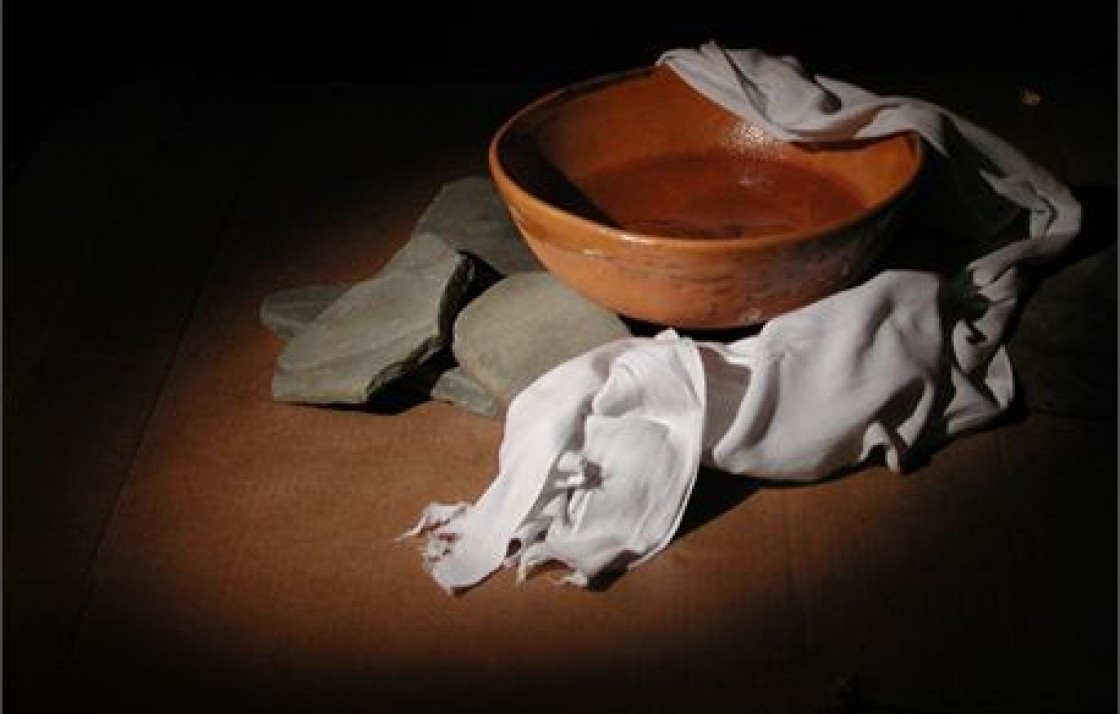
Their desire to be first in the kingdom of heaven may help explain why none of them wanted to take on the role of a servant when they arrived at the house where they would share the meal. Normally, a host would set out a bowl of water for guests to wash their feet, since travelers’ feet would be dirty after walking the dusty roads of first-century Palestine. In wealthier homes, it would be the job of a servant to fill the basin, and sometimes even to wash the guests’ feet.
But none of Jesus’ disciples wanted to be seen as lower than the others. No one wanted to take on that humble task. And so each of them reclined at the table with dirty feet.
Jesus knew that if the disciples were going to carry on his work after he was gone, they needed to understand one foundational truth: that greatness in the kingdom of heaven is not about exercising power over others, but about serving others. And so during this final meal, Jesus gave them a living example of what that kind of love looks like.
He got up from the table, wrapped a towel around his waist, and began to wash the feet of each and every one of his disciples.
N. T. Wright once said about communion, “When Jesus himself wanted to explain to his disciples what his forthcoming death was all about, he didn’t give them a theory, he gave them a meal.” And the same could be said about this moment. Jesus did not just tell his disciples to serve one another. He showed them. He knelt before them and washed their feet, and then said, “Just as I have done for you, you also ought to do for one another.”
One thing that strikes me about both of these acts is that they only fully make sense in community. We can wash our hands anytime, and especially during cold season I hope we do so regularly! But it becomes something more when we wash one another’s hands.
In the same way, we can eat bread and drink juice anytime, but on their own they are just food. It is when we share them together, when we serve one another, that they become a powerful reminder of Christ’s life, death, and resurrection.
It is in community that we remember that Christ gave his life for us. And it is in community that we are called to give our lives for one another.
Amen.
 Hampden United Methodist Church