
April 12, 2026 John 20:19–31 homily by Pastor Galen for the Second Sunday of Easter
“Jesus said to him, ‘Have you believed because you have seen me? Blessed are those who have not seen and yet have come to believe.’” – John 20:29
Journey to the Moon
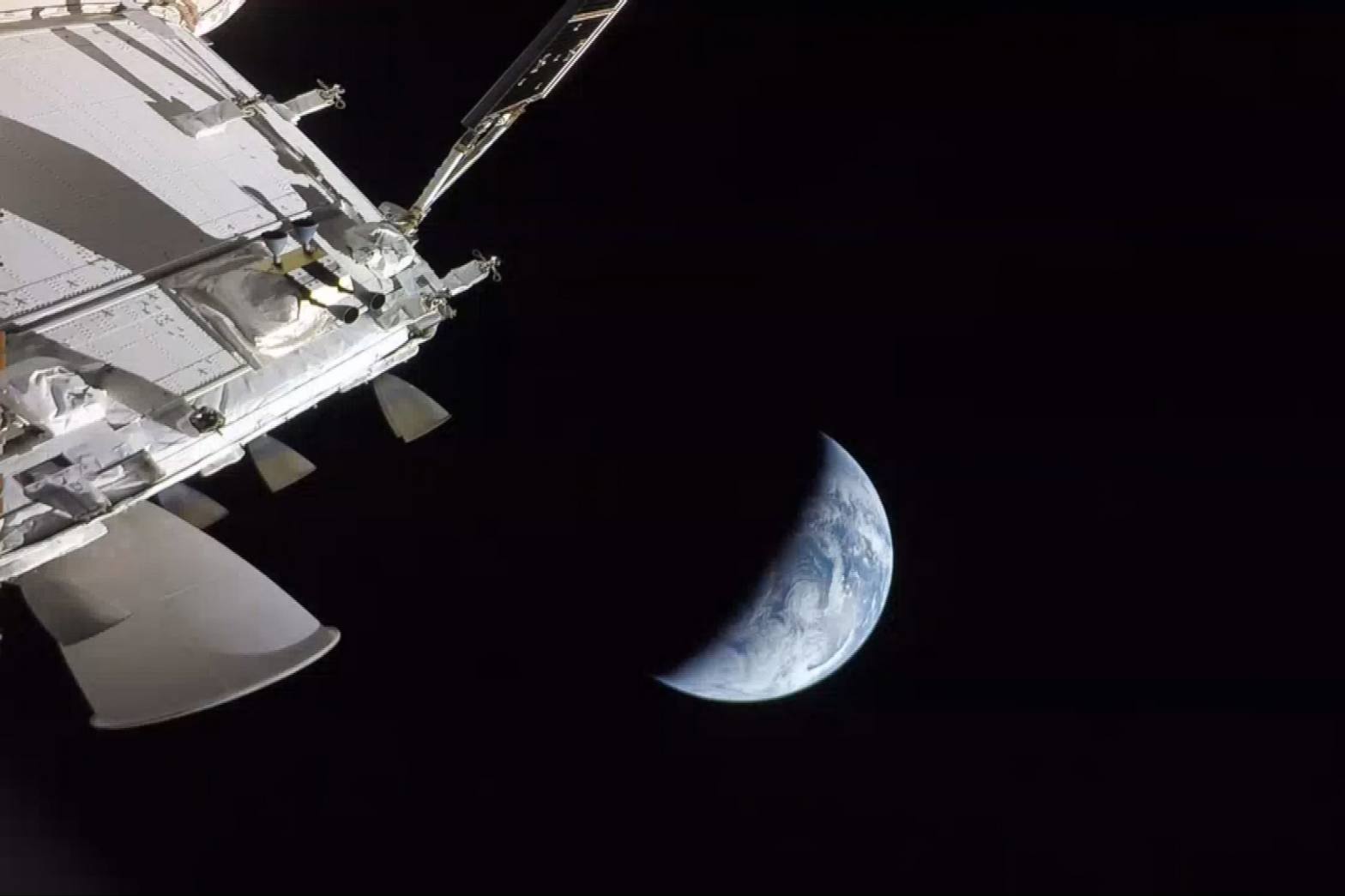
On Friday evening, our family was glued to the TV watching the return of the Artemis II space mission.
It was an incredible space mission: the first crewed mission to the Moon in over 50 years, and one that took human beings farther from Earth than ever before. It was especially fun to see an astronaut who grew up in Baltimore County on that mission.
More than anything, we were grateful that they made it back safely. But as I’ve been reflecting on the Artemis II space mission, I found myself thinking about the astronauts in relation to faith.
Because there’s no way that those astronauts could have fully understood everything that went into getting them there. All of the mathematical equations, all of the technology, all of the astrophysics behind that launch, it’s far beyond what any one person could hold in their head.
What they had to have was faith. Faith in the expertise of the community that made that mission possible: The mathematicians. The engineers. The communications teams. The project managers. And the list goes on. Certainly the astronauts had extensive training and education and expertise. But they also had to have faith in the wisdom and expertise of the community that launched them into space. They didn’t need to understand everything. They needed to trust the people who did.
Eyewitness Testimonies
And in many ways, that’s not so different from our own faith journeys. Because none of us were there when Jesus walked the earth. We didn’t see him in his resurrected body. We didn’t have the opportunity to hear his voice in person. And yet, we have faith.
We believe, in part, because of the eye-witness testimonies that were passed down to us. Those who were there when Jesus walked on this earth, those who saw the risen Christ. Those people shared those stories, and many of them gave their lives for the cause of Christ. They told their stories to others, who carefully wrote them down. And then generations and generations from the time of Christ have meticulously preserved and translated and passed down those accounts so that even today we can read and hear for ourselves what those eye-witnesses experienced.
Just like the astronauts on Artemis II trusted their community to launch them into space, so too our faith involves, in part, trusting the community that witnessed and passed down and preserved the accounts of Jesus’ life, death, and resurrection.
Doubting Thomas
But sometimes it’s difficult to trust others. And Thomas is a case in point.
Thomas was one of Jesus’ twelve apostles. He had left everything to follow Jesus. He had seen Jesus perform miracles, and even raise the dead. He had heard Christ’s teachings firsthand. He had seen Jesus get arrested and knew that Jesus had been crucified and laid in a tomb.
But his journey had not been a single, solitary journey. He had traveled together with the other disciples for those three years. They had been together through thick and thin. Most likely Thomas had even been one of the apostles who had been sent out by Jesus two by two to heal and cast out demons in Jesus’ name. The twelve of them had been together this whole time. And yet, when the other apostles told him, “We have seen the Lord” (John 20:25), Thomas didn’t believe them.
And I think it’s worth asking, why? Why wasn’t Thomas there when all of the other disciples were gathered together, and Jesus first appeared to them? And when all of the other disciples told him that they had seen the risen Christ, why did he not believe them? Why did he say he needed to see Jesus for himself?
We don’t really know what was going on for Thomas. No doubt he was overwhelmed with grief. Most likely he felt disoriented and disappointed, and angry at those who had crucified Jesus. No doubt all of the disciples had felt that way.
But why didn’t Thomas believe his friends? Why did he think they would lie to him?
I have to wonder if perhaps Thomas had been hurt or lied to in the past. Maybe someone in his family or community had let him down in the past. Maybe someone he trusted deceived him, and he didn’t want to allow himself to experience the same thing all over again.
In this way, there are probably some here today who can relate to Thomas a little bit. Perhaps you’ve been hurt or lied to or let down by others in the past, and so you tend to be a bit guarded, and hesitant to trust even those closest to you.
The Faith of Thomas
But whatever the reason Thomas didn’t believe the other disciples, Thomas was honest, and he named what he needed in order to believe. Specifically, he said that he needed to see and touch the marks of the nails in Jesus’ hands and the place where Jesus’ side had been pierced (John 20:25).
I have to wonder what that following week was like for Thomas and the others. The whole week, the other disciples were excitedly talking about how happy they were that Jesus had risen, and saying, “oh Thomas, if only you had been here, you would have seen him for yourself! It was so amazing!” But although Thomas just couldn’t let himself believe, he also didn’t disengage or go off on his own. He stayed and waited with the others, to see if Jesus would appear to them again. And sure enough one week after Jesus had appeared to the disciples, Jesus appeared to them again, and this time, Thomas was there with them.
I find it beautiful that Jesus addressed Thomas directly. He didn’t shame or dismiss him. Rather he extended an invitation, saying, to Thomas, “Put your finger here and see my hands. Reach out your hand and put it in my side. Do not doubt but believe” (John 20:27).
And after Thomas does so, he utters one of the most powerful confessions in all of Scripture, saying: “My Lord and my God” (John 20:28). In the Gospel of John, Thomas is the first person recorded in the New Testament to directly address the resurrected Jesus as “God”! What a profound declaration of faith!
So often we focus on Thomas’ doubt, but in the end, Thomas’ doubt was not a barrier to belief, but rather part of his journey of faith.
Tradition tells us that Thomas went on to become a missionary as far as India, carrying the message of the risen Christ to places far beyond where the other disciples went. The one who previously doubted became the one who helped others believe!
Faith Journeys
Of course, there are different ways that people come to believe. Some of us come to faith through the testimony of others. Some through careful study and reflection. Some through personal experience: moments where we sense Christ’s presence in a way that we can’t quite explain. A still, small voice. A deep sense of peace. A moment of clarity.
There’s a line in the hymn, He Lives, that says, “You ask me how I know he lives? He lives within my heart.” And for some of you, that’s your story.
Jesus has a word for all of us who have never seen him in the flesh. He said to Thomas, “Have you believed because you have seen me? Blessed are those who have not seen and yet have come to believe” (John 20:29). I love that Jesus met Thomas right where he was, in all of his doubt, and also that Jesus affirms those of us who don’t have the benefit of seeing him in his resurrected body, and yet have come to believe.
We see here in the story of Thomas that not all of our journeys are alike. And that’s OK! It’s OK even to have doubts. The question is: what do we do with our doubts? Do we ignore them? Do we push them aside? Or do we actively search for the truth, and stay connected with others on this journey, knowing that we do not have to journey alone.
A question, too, for those who may have an easier time believing, who may not struggle as much with doubt: will we welcome and include people in our community who struggle with doubts, as the other disciples welcomed and included Thomas, or will we push them away or ostracize them? My prayer is that we would be a community of faith that welcomes all, whether they believe or doubt, recognizing that all are invited on this journey of faith.
Faith and Faithfulness
But there’s one other question we have to ask. Because the question is not just what do we do with our doubts, but also, what do we do with belief?
And this is where I think those astronauts give us a helpful picture. Because they didn’t just believe that it was possible to go to the moon. They didn’t just trust the expertise of their community. They also acted on that belief. They stepped onto the spacecraft. They trusted enough to go.
And that’s the invitation for us. Faith isn’t just something we hold in our heads. It’s something we live. Faith and faithfulness come from the same place. To have faith in Christ is to trust him enough to follow. To take the next step, even when we don’t have everything figured out.
Stepping out in Faith
So the question for us is this: Are we willing to take that step? Are we willing to trust, not just in theory, but in practice?
Because faith isn’t just about believing the right things. It’s about trusting enough to move. Trusting enough to forgive. Trusting enough to serve. Trusting enough to follow where Christ is leading, even when we don’t have all the answers.
The astronauts on Artemis II didn’t wait until they understood everything before they got on the spacecraft. They trusted the community that made the journey possible.
And in the same way, Christ calls us.
Not when we have perfect certainty.
Not when all our doubts are resolved.
But right now.
So may we be people who take that step.
People who trust enough to follow.
People who discover, along the way, that the risen Christ is already here, meeting us, guiding us, and calling us into new life.
Amen.
Questions for Personal Reflection in Response to today’s message:
- Where in my life am I being invited to trust, even when I don’t fully understand?
- How have my past experiences shaped my ability (or hesitation) to trust others or God?
- When I experience doubt, do I hide it, ignore it, or bring it honestly before God?
- In what ways is Christ inviting me to move from belief into action right now?
- How can I help create a community where questions and doubts are welcomed rather than judged?
 Hampden United Methodist Church