
September 20, 2026 homily on Exodus 16:2-15 and Matthew 20:1-16 by Pastor Galen
“When the Israelites saw it, they said to one another, “What is it?” For they did not know what it was. Moses said to them, “It is the bread that the Lord has given you to eat.” – Exodus 16:15
Thanks! What Is It?
Have you ever received a present from someone, but when you opened it up, you had no idea what it was? You were honored that the person thought of you and took the time to buy or make you a gift, but you honestly had no idea what it was. You look up with a feigned look of delight, but you cannot hide the confusion on your face as you say, “Thanks! But what is it?”
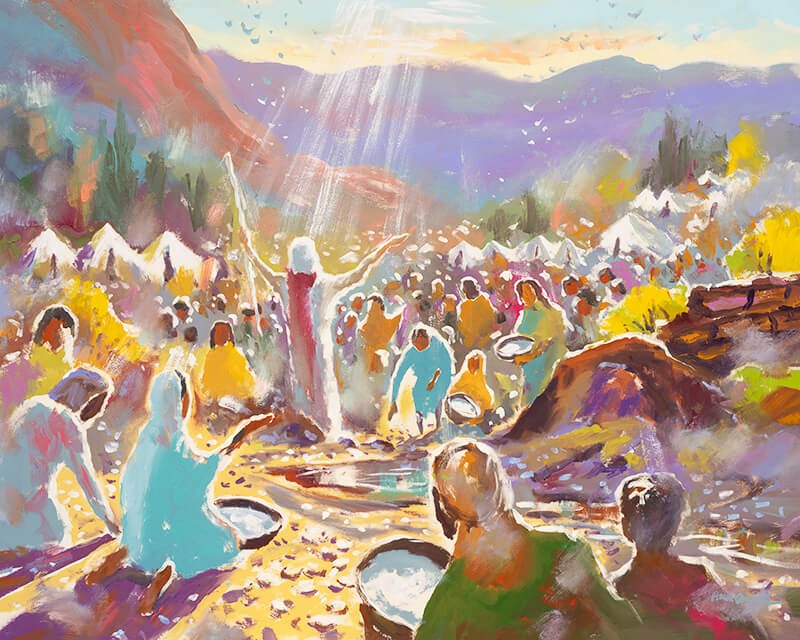
This is the question that the Israelites asked when they walked out of their tents in the morning and saw the substance that God had caused to rain down out of the sky for them to eat. The name that they gave the substance—manna—literally means in Hebrew, “What is it?”
Prior to this, the Israelites had been complaining that they had nothing to eat. They even said that they wished that they were back in Egypt, where, according to them, they “sat by the pots of meat and ate [their] fill of bread” (Exodus 16:3). Of course, they were looking back on the past with rose-colored glasses, since for generations they had been enslaved. It’s very unlikely that they literally sat by pots of meat! Still, in Egypt they usually knew where their next meal would come from, whereas here in the wilderness they had no clue how or where to find food. Here in the wilderness, they were completely dependent upon God to provide them with their daily food.
So the people had complained to Moses, and Moses prayed to God. God miraculously provided what they needed: quail—sort of like little pheasants—for meat in the evenings, and a ‘fine flaky substance, as fine as frost on the ground’ (Exodus 16:13) that they could make into bread in the mornings.
Lessons from Manna
Now, there are several things that I find quite interesting about the way God provided for the people in the wilderness.
- The people still had a part to play. Yes, God miraculously brought the quail and manna their way. But they had to go out and collect the quail and roast them over the fire to cook them. The manna too had to be collected and turned into bread. Numbers 11:8 describes how the Israelites prepared the manna they gathered in the wilderness, grinding it into flour or crushing it before cooking it into cakes that tasted like fresh olive oil.
- God orchestrated the miracle in such a way that everyone received exactly what they needed.
Approaching this passage as 21st-century consumers and entrepreneurs, we would probably be tempted to collect more than what we needed so that we could sell the extras to those who failed to gather enough, thereby making a profit. But God made it impossible for the Israelites to do so. Those who tried to hoard more of their share of the manna found that, when it was all measured out, they had no more than those who had gathered little (Exodus 16:18).
On the one hand, this may not seem fair. The people who worked really hard and gathered a whole lot didn’t end up with any more manna than those who didn’t gather as much. But on the other hand, it was extremely fair, because in the end, everyone had exactly what they needed.
They also found out that the manna generally couldn’t be collected and stored. If they tried to keep some until the next day, they woke up to find that the manna from yesterday was “wormy and rotten” (Exodus 16:20). They had to just consume what they needed for that day, and trust that God would provide more manna for them the next day. The only exception was the day before the Sabbath. On that morning the people were instructed to gather twice as much as they needed so they wouldn’t have to go out and gather manna on the Sabbath. Sure enough, they found that the manna didn’t even fall from the sky on the Sabbath. God was teaching them to balance work with rest, and not to hoard or stockpile, but instead to trust God each and every day. And God was also teaching them that if they would look to God as their source of provision, then they could trust that there would be enough for everyone.
The Vineyard Owner
In the Gospel of Matthew, we encounter a story that has many parallels to the story of the manna in the wilderness. In Matthew 20, Jesus tells a parable about day laborers who are waiting around for odd jobs to do. We might picture them standing in the Home Depot parking lot, waiting for someone to come along and hire them for the day.
One day, a vineyard owner came along early in the morning and hired several of the laborers, providing them with a full day’s work harvesting in his vineyard. He came back a few hours later and hired more. He returned again later in the day, and then at around five o’clock, an hour before closing time, he came back and hired the last few laborers.
When it was time to call it a day, he called all of the day laborers together and paid each of them a full day’s wage.
Those who had worked only an hour were undoubtedly ecstatic. Getting paid a full day’s wage to work only an hour or so was unheard of! They were no doubt grateful for the abundant generosity of the owner who paid them far more than they expected.
Of course there were also the workers who had been working since before the sun came up. They were enraged. Why were they given the same amount as those who were hired later in the day? Why wouldn’t the owner of the vineyard pay them several times as much? What was the point of them laboring so hard all day when those who had spent most of the day waiting for work were paid the same amount?
As with the manna, where those who tried to gather more than they needed found that they had the same as those who gathered little, in the parable of the vineyard workers, those who worked for only an hour received the same wages as those who had worked hard all day.
What Is God Doing?
The question that comes up in response to this parable is the same question that the Israelites asked when they saw the flaky substance on the ground that God had rained down out of the sky: “What is it?” What is the lesson Jesus was trying to teach?
Well, the money that the vineyard owner pays the workers in this parable is symbolic of the mercy and salvation that God offers to all. We know that salvation is not dependent on our work or effort, but is purely an act of grace. Salvation is a gift, an act of God’s unmerited favor. Those who experience deathbed conversions receive the same forgiveness as those of us who were placed on the cradle roll when we were born.
To those who have worked hard for Jesus all their lives, that may not seem fair. Why does someone who has lived a life of sin and then turns to God right before they die receive the same grace and mercy and forgiveness as someone who tried to do what was right all of their lives?
The Gift of Salvation
But the reality is that none of us are deserving of God’s grace and mercy. No one, apart from Christ, is perfect. “All have sinned, and fall short of the glory of God,” as we read in Romans 3:23. Romans 6:23 tells us that “the wages of sin is death; but the gift of God is eternal life through Jesus Christ our Lord.”
Even if we have worked hard for Jesus all of our lives, we all fall short of the glory of God. And so we are no more deserving of God’s grace and mercy than someone who rejected God for their whole life. Salvation is purely a gift from God, offered freely to all — like the manna in the wilderness, and like the workers who were paid a full days wages, no matter how long they worked.
This is why Romans 5:8 tells us that “God commendeth his love toward us, in that, while we were yet sinners, Christ died for us.”
Of course, the gift of God does necessitate a response on our part. Just as the Israelites had to go out and collect the manna and grind it into flour and bake it, and just as the workers accepted the vineyard owner’s invitation to work in the vineyard, so too, the gift of salvation requires a response on our part. Romans 10:9 says, “If thou shalt confess with thy mouth the Lord Jesus, and shalt believe in thine heart that God hath raised him from the dead, thou shalt be saved.” Romans 10:13 reminds us that this invitation is available to anyone, regardless of their background or station in life. “For whosoever shall call upon the name of the Lord shall be saved.”
God’s abundant generosity, seen in the provision of manna in the wilderness and in the vineyard owner’s generosity to the workers in the vineyard, challenges our preference for everyone getting what we think they deserve. And the abundant grace we receive through the shed blood of Jesus Christ on the cross reminds us that forgiveness is a gift that none of us could ever earn.
Jesus—the Bread from Heaven
In the Gospel of John, Jesus referred to himself as the “true bread from heaven.” In John chapter 6, Jesus said, “Very truly, I tell you, it was not Moses who gave you the bread from heaven, but it is my Father who gives you the true bread from heaven. For the bread of God is that which comes down from heaven and gives life to the world.”
They said to him, “Sir, give us this bread always.” Jesus said to them, “I am the bread of life. Whoever comes to me will never be hungry, and whoever believes in me will never be thirsty” (John 6:32–35). Jesus, the true bread from heaven, gave his life for the world. What an amazing gift!
The generosity of God is beyond anything we could earn through our own effort. We recognize our need and dependence on God and receive this great gift that has been offered to us. And when we begin to recognize how much we have received from God, it changes the way that we look at what has been entrusted to us.
Our Response
How then do we live in response to a God who provides for our needs, a God who is lavish in generosity and grace? Perhaps one of the questions for us this morning is simply: What has God already placed in our hands? God has given each of us time, relationships, abilities, resources, and opportunities that can be used for the benefit of others. As a congregation, God has given us a place in this community and relationships with people who come through our doors for many different reasons. These things may seem ordinary, but the manna in the wilderness probably seemed ordinary too after a while. God can take what has already been given to us and use it as part of God’s provision for someone else.
The Israelites looked down at the ground and asked, “What is it?” They eventually discovered that God had already provided what they needed. Perhaps we need to look again at what God has already given us—with gratitude for the grace we have received, and with a willingness to use those gifts faithfully. The same God who provided manna in the wilderness, who showed extravagant generosity through the vineyard owner, and who gave us the Bread of Life still provides for us today. May we have the wisdom to recognize God’s gifts and the faith to use them well. Amen!
Questions for Personal Reflection:
- Where have you experienced God’s provision in a way you did not expect?
- Is there something in your life that seems ordinary but may actually be a gift from God?
- What makes it difficult for you to trust that there will be enough?
- How does remembering that God’s grace is a gift shape the way you view and respond to others?
- Where do you see God already at work in our church, neighborhood, or community?

